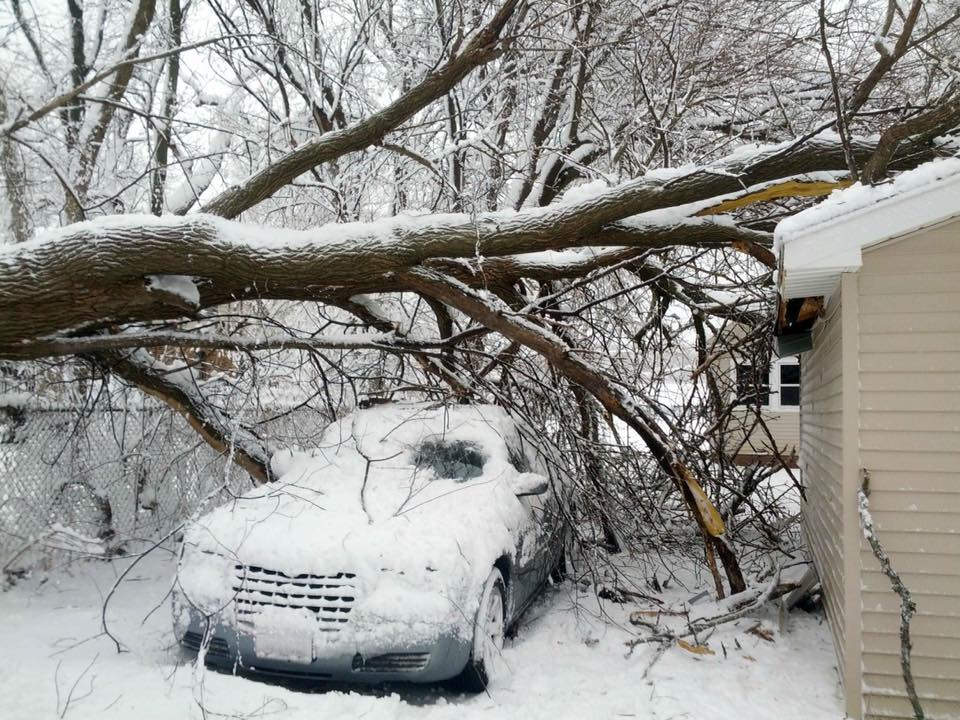
Most homeowners in Central New Jersey only call a tree service after something has already gone wrong — a limb on the roof, a trunk through the windshield, a hollow tree finally giving up during a nor'easter. By that point, the bill is split between the tree work and the repairs.
The good news: almost every hazardous tree shows you it’s in trouble for months or years before it falls. You just have to know what to look at. After 40 years of removing trees in Piscataway, Edison, and the rest of Middlesex County, here are the five signs we tell every homeowner to watch for — in order of how seriously we treat them when we walk a property.
1. Cracks or splits where the trunk forks
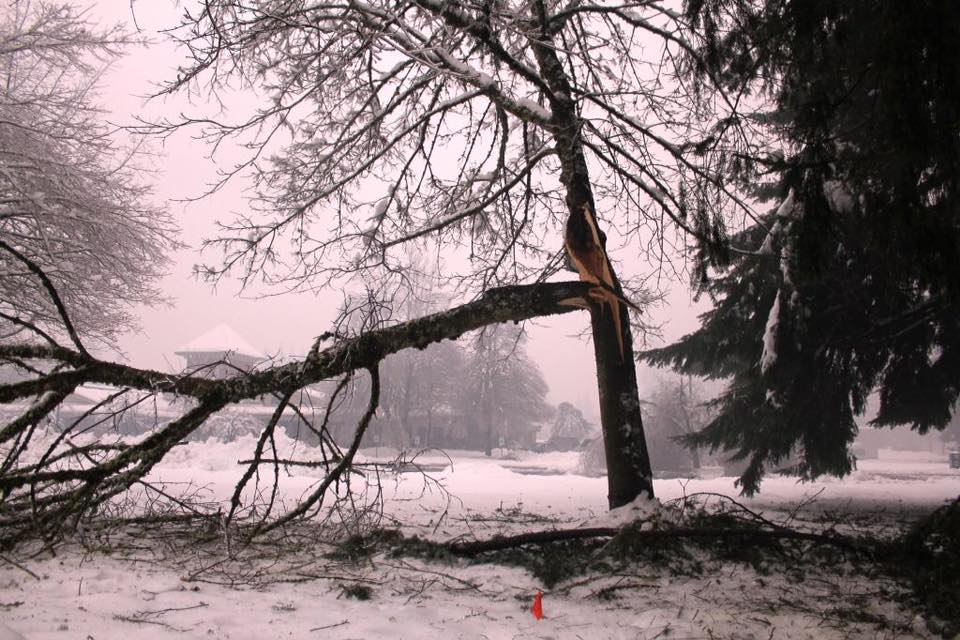
Walk to where the trunk splits into two or more main stems. Look at the V (or U) where they meet. If you can see a crack running down into the trunk — even a hairline one — that’s called a cracked union, and it’s the single most common failure point on big residential hardwoods.
The tighter the V, the worse the structural risk. Tree biologists call these included bark unions: bark gets trapped between the two stems as they grow, which prevents proper wood-to-wood fusion. Eventually wind, ice load, or just the weight of summer leaves splits the union open. Maples, oaks, and locusts are notorious for this.
If a cracked union is over your house, your driveway, or any structure you care about, get an arborist to look at it. Some can be saved with structural cabling. Some can’t.
2. Mushrooms or shelf fungus on the trunk or surface roots
Fungal conks — the mushroom-shaped or shelf-shaped growths that pop out of bark — are almost always a sign of advanced internal rot. The conk is just the fruiting body. The actual fungus has already been eating the heartwood, sometimes for years.
The species matters:
- Honey fungus (Armillaria) on root flares = root rot. Most trees with serious Armillaria infection don’t survive 2–3 more growing seasons.
- Ganoderma shelf fungus low on the trunk = butt rot. The base of the tree is structurally compromised.
- Inonotus on oaks = sulfur shelf rot. Usually means the heartwood is hollow even though the tree still leafs out.
Tap the trunk at the base with a rubber mallet or a piece of firewood. A solid, healthy trunk thuds. A hollow or rotten trunk sounds dull and drum-like. If you hear hollow, schedule a hazard assessment.
3. A new lean — especially with raised soil at the base
A long-standing lean isn’t necessarily a problem. Trees lean toward sunlight; many of the healthiest trees in your neighborhood have a 5–15 degree natural tilt they’ve carried for decades.
What you’re looking for is a new lean. Specifically:
- Soil heaved or cracked on the side opposite the lean (the root plate is lifting)
- Exposed roots on the lean side that used to be buried
- The angle changed visibly between last summer and this one
A new lean means the root system is failing. Once the root plate starts lifting, the tree is on a clock measured in storms, not years. We’ve taken down trees in Edison and South Plainfield that had visibly leaned 8–12 inches over a single wet spring. After heavy rain or wind events, walk your trees and check for this.
4. Dead branches in the upper canopy
A few dead twigs are normal — trees self-prune. What matters is the pattern.
Dead wood concentrated in the upper canopy (the topmost third of the tree) is a serious warning. The top of the tree is the most vascular-demanding part; when it dies first, it usually means the tree’s ability to move water and nutrients up the trunk is failing. That can be from drought stress, root damage, vascular disease (like oak wilt or Dutch elm disease), or insect borers.
For ash trees specifically, upper-canopy dieback that progresses fast over one season is the classic sign of emerald ash borer infestation — a problem that has devastated NJ ash populations since 2014.
Limbs that die in place don’t stay attached forever. They become the “widow makers” that fall in the next storm. If the dead wood is over a structure or a regularly-used part of the yard, it’s a removal candidate even if the rest of the tree still leafs out.
5. Cavities, hollows, or large wounds in the trunk
Smaller cavities can sometimes be tolerated — trees compartmentalize damage and live around it. The question is the proportion.
The general rule arborists use: if the diameter of the cavity (or the dead area) is more than one-third the diameter of the trunk at that point, the structural integrity is too compromised to leave standing over a target (a house, a regularly-parked car, a deck, a frequently-used patio).
Old wounds also matter. A trunk wound that’s never sealed over — bark dieback that keeps spreading, exposed wood that’s gone dark or punky — means the tree isn’t winning the fight against decay.
Not sure what you’re looking at?
If something on this list sounds like a tree you own, we’ll come look at it. Free estimate, no pressure to remove anything that doesn’t need it. Forty years on, we’re still in this business because we tell people the truth about their trees.
What we don’t consider a removal trigger
Just as important as what to look for is what not to panic about:
- Bark peeling on sycamores, birches, paper-bark maples — that’s normal. These species naturally exfoliate.
- Sap weeping from minor wounds — trees seal wounds with sap. A little is healthy.
- Lichen on the bark — lichen doesn’t harm trees. It just grows on the surface.
- Some root flare visible — this is normal. What you don’t want is roots that used to be buried suddenly exposed.
- Hollows where birds nest — if the cavity is small relative to the trunk and the tree is otherwise healthy, leave it. Wildlife trees have value.
The whole point of a hazard assessment is figuring out the difference between “needs to come down” and “needs a cable, some pruning, or just a watch.” Plenty of trees in Central NJ get flagged for removal that we end up saving with structural pruning or a single bracing rod.
Bottom line
If you have one of these five signs and the tree is over something you care about, get a free assessment. Most of these problems are visible from the ground in five minutes. The cost of acting early is a fraction of the cost of acting after the tree falls.
Forty years in, the most common thing we hear is, “I knew it didn’t look right but I kept putting it off.” Don’t do that.